Houseplant care: guides and stories
Monstera deliciosa: from a small pot to a substantial climber
Changing leaves, aerial roots and an increasingly large plant: how to understand your Monstera before reaching for another intervention.
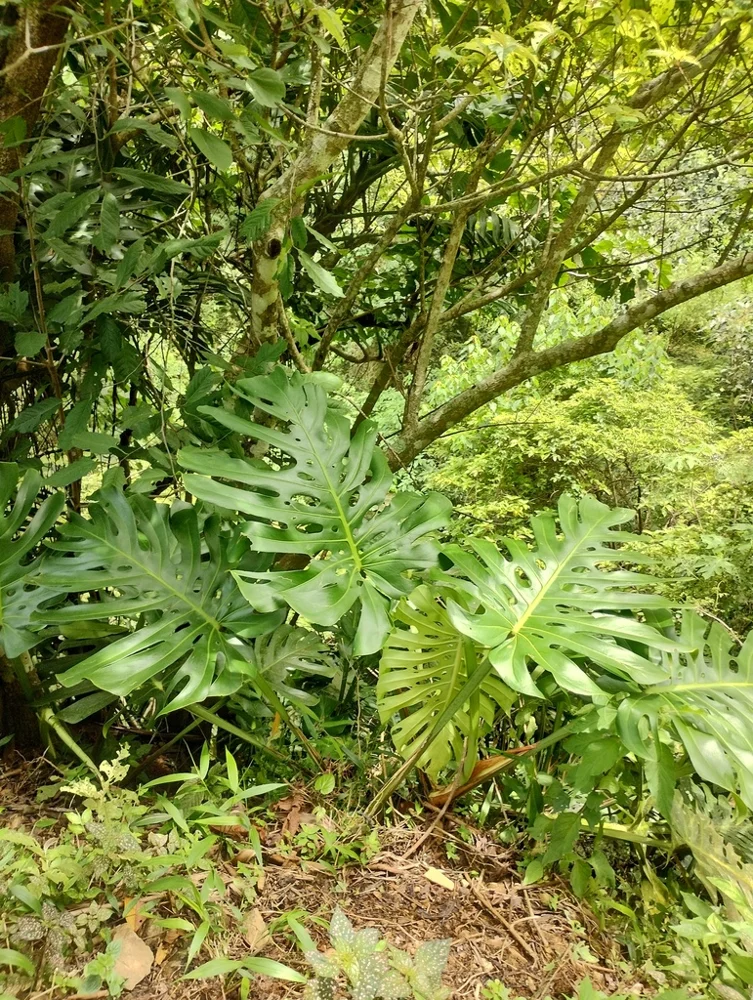
A young Monstera fits neatly on a windowsill. A few leaves and a modest pot give little reason to plan the rest of the room. Then a new leaf reaches over a chair and the stem starts leaning towards the window. What looked like a green accessory now needs a place of its own. This is a useful moment to ask what kind of plant you have brought home.
Monstera deliciosa is a tropical climber from Mexico to Panama. The University of Wisconsin describes its aerial roots attaching to trunks and branches. A living room offers different opportunities from a forest tree, but a decorative pot does not remove the plant's tendency to seek space and support.
Holes are not a scorecard
Young leaves can be entire. Splits and openings generally appear as the plant develops. It is tempting to judge each new leaf by its number of holes, especially when social media shows a spectacular leaf from a much larger specimen.
An entire leaf does not prove poor care, and a deeply divided leaf does not prove that every condition is ideal. Compare your plant with itself. Have successive leaves become smaller? Has the spacing between them changed? What happened after you moved the pot? Photographs from a similar angle create a useful record without comparing your specimen with an unfamiliar plant online.
There are hypotheses about the evolutionary advantages of leaf openings. We do not present a single explanation as settled fact. For home care, it is more useful to recognise the interaction between development and growing conditions than to assign a definite story to every hole.
Plan where the stem will go
The RHS describes aerial roots as part of the climbing habit. Before treating them as clutter, look at the stem's direction and decide how to support it. Choose something genuinely sturdy enough for the plant's weight.
Distinguish the stem from the leaf stalks. Secure the supporting part while allowing leaves room to orient themselves. Do not force a rigid root around a sharp bend. Installing suitable support while a plant is small gives you more options than straightening a heavy climber later.
A moss pole creates a separate care task. The pole and pot can dry at different rates. Always watering both together hides that difference. Record pole maintenance separately: a dry pole does not establish that the root ball is dry, and a moist root ball does not tell you how much moisture remains higher up.
Look at light where the leaves are
The RHS recommends bright indirect light indoors. That is a starting point rather than a precise measurement of your room. Light at eye level may differ from light beneath a dense canopy. A neighbouring plant, curtain or shelf can change the situation.
As a practical exercise, record which leaves face the window and which face the room. Change one thing at a time and allow time to observe the result. Otherwise the next leaf cannot help you judge which adjustment mattered. With a grow light, record distance and operating duration; 'under a lamp' is not enough information for a later comparison.
Watering starts with this particular pot
A large leaf is impressive, but it is not a moisture gauge. The RHS describes moist, well-drained growing conditions; Wisconsin recommends allowing the medium to dry slightly between watering. Neither establishes a fixed weekday for every Monstera.
Our practical interpretation is to consider the medium, root zone and growth together. Check a comparable position each time, notice pot weight and record changes. A recently repotted root ball in a large container differs from a densely rooted pot. Under grow lights, active growth can continue during the outdoor winter. The season's name should not replace observation.
With a reservoir, separate two questions: how much water is below, and how much moisture is available near the roots? An empty indicator reports the reservoir level. It does not establish a universal root-zone threshold. Follow your verified pot profile rather than increasing the maximum fill simply because a leaf has grown larger.
Put a yellow leaf in context
Record which leaf changed, when it started and whether other signs appeared. One older leaf and several rapidly discolouring leaves are different situations. Photograph both surfaces and inspect the leaf axils. Colour alone cannot reliably distinguish dryness, root trouble and pests.
Avoid adding water, fertiliser and a larger pot all at once. Start by checking whether the root ball is wet, whether growth continues and whether insects or damage are visible. The RHS also warns that ingestion is harmful and contact may irritate skin or eyes. Keep the plant away from chewing pets and wear gloves when cutting.
A plant that grows with your home
A useful journal need not be lengthy. 'New leaf opened, support adjusted, pot still moist' can be more informative than automatic watering dates. Add an overview photograph when its shape changes. You can then recognise a space problem before the plant blocks a walkway.
A mature Monstera need not resemble a showroom specimen. Following its development is part of its value. Planning space, support and care together lets the large leaves remain a pleasure rather than a repeated problem.
Sources and limits
Growth habit and general cultivation conditions were checked against the university and RHS sources below on 6 October 2026. Photography, separate checks and pot-profile examples are our practical editorial interpretation, not an experimentally validated recipe for every medium or cultivar.