Houseplant care: guides and stories
Root rot and dry rot: recognise, prevent and respond
Why a wilting plant does not always need water: root decay, dehydration damage, prevention and responsible salvage.
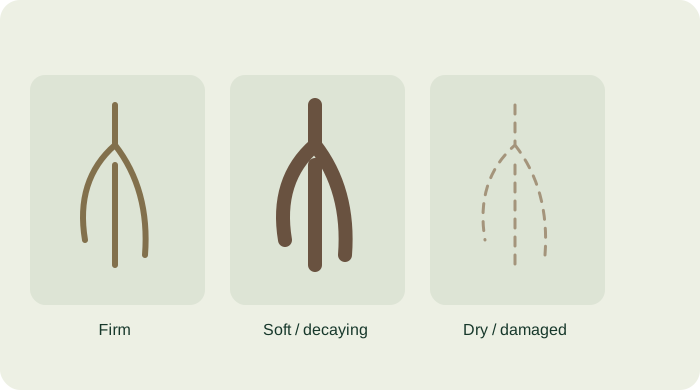
A plant wilts and the watering can is already in your hand. Pause first. Damaged or decayed roots may fail to take up water even in a wet pot. Adding more can be the wrong answer. This guide helps you distinguish observation from diagnosis before choosing a response.
What is root rot?
Root rot describes deterioration of root tissue, often involving pathogens. Iowa State lists Pythium, Phytophthora, Rhizoctonia and Fusarium among the organisms involved. Not all root death is infectious: unsuitable conditions can also damage roots directly. A photograph does not identify a pathogen; a specific disease diagnosis may require testing.
Prolonged wetness and poor root-zone aeration increase risk for many houseplants. The problem is broader than watering frequency. Container size, blocked drainage, low light and a persistently wet core can interact. The pot's history matters more than judging one watering event.
What does dry rot mean?
Houseplant discussions sometimes use dry rot for roots that died through dehydration. That usage is not an unambiguous diagnosis. Elsewhere the term can name specific diseases. A dry-looking root therefore does not establish death from drought. Here we prefer dehydration damage or root death when that is what is suspected.
Drought injury and decay can occur in the same specimen. Their order may be impossible to reconstruct. Record facts: medium moisture, refill history and which roots remain firm. Do not record an unconfirmed organism as the cause.
Examine roots carefully
First check moisture, reservoir, drainage and recent changes. If signs warrant unpotting, support the root ball rather than pulling fragile stems. Photograph the original arrangement before removing material.
Decayed roots may be mushy, collapsed and lose their outer layer. Healthy roots should be firm but are not universally white. Age or substrate staining alone does not justify cutting everything away. Consider texture, extent, remaining roots and plant condition together. Colour and smell are clues, not laboratory findings.
Dehydrated roots may look shrivelled or brittle, but appearance alone does not identify the cause. The illustrations are schematic comparisons, not a photographic diagnostic test.
Prevent further damage
Separate a suspect plant and keep its drainage away from others. Inspect over a dedicated tray. Clean tools and work surfaces between plants using an appropriate product's instructions. Do not reuse potentially contaminated rinse water across a collection.
In potting mix, allow excess water to drain and empty trapped water from a decorative cover pot. In semi-hydro, check the intended level, root position and delivery. Do not blindly lower a reservoir until surviving roots dry out. The aim is an appropriate root environment, not maximum dryness.
When repotting may help
Limited damage with sufficient living roots may permit a careful salvage attempt in clean, suitable medium. Remove clearly dead, mushy sections using clean tools; retain firm roots and avoid unnecessary injury. Match the container to the surviving root ball. A larger pot is not automatically helpful after root loss.
This is not a guaranteed cure for every infection. If the stem base or growing centre is affected, deterioration continues rapidly or little sound tissue remains, the plant may be beyond recovery. A valuable specimen or repeated losses warrant targeted diagnostic help rather than a succession of products.
A healthy cutting may be an alternative, depending on species and damage location. Use suitable, unaffected material and the plant's propagation method. Some leaves can root without producing a whole new plant. A cutting also cannot guarantee freedom from a suspected disease.
Avoid universal peroxide recipes
Hydrogen peroxide, cinnamon and other home remedies feature in online advice. We do not prescribe a universal root bath or concentration: effectiveness, tissue damage and suitability vary, while the causal organism is often unknown. Dead roots cannot be brought back to life by a treatment.
Fungicide is not a default next step either. Appropriate use needs an evidenced cause and current approval for the plant and purpose. An American gardening publication is not a Dutch list of authorised products. Growing conditions still need correction even where targeted treatment is possible.
Recovery without conflicting changes
After intervention, record surviving roots, container, medium, position and actions. Maintain suitable, stable conditions. Do not simultaneously increase lighting, add extra fertiliser and introduce a new growing system to force recovery.
Water according to actual conditions and plant needs. Damaged roots do not establish a fixed drying period in days. Existing leaf damage can be permanent; a brown area need not turn green to indicate recovery. Follow new growth and progression without unpotting the plant every day.
Prevention in potting mix
Match container and medium to the roots and environment. Confirm drainage and check that the decorative pot does not trap water. A description such as airy aroid mix cannot replace inspecting how the actual mixture behaves.
Pay attention after repotting, relocation and changes in lighting or temperature. A previously fast-drying pot can remain moist longer elsewhere. Preserve observations and adjust the profile when repeated checks support it. A fixed watering calendar cannot capture all those differences.
Prevention in Pon, LECA and reservoirs
Semi-hydro does not eliminate root trouble. Record refill level, maximum fill height and root-zone moisture separately. Keep reservoirs accessible. Check a wick or indicator when plant response differs from expectations.
An organic core can behave differently from surrounding mineral medium during transition. Record that explicitly. A low reservoir does not prove a dry core; visible water does not prove delivery works everywhere. Review the arrangement after construction or root-system changes.
A useful checking sequence
With wilting or discolouration, check current moisture and context first. A wet root ball with decline calls for root and drainage inspection. A dry root ball calls for assessing delivery and dehydration without automatically naming infection. Soft, deteriorating tissue calls for recording extent and judging whether careful salvage is possible.
Keep an overview photograph and a brief follow-up in your journal. The next check then asks whether damage has spread, moisture remains appropriate and growth has appeared. That is more informative than simply recording 'root rot treated'.
Sources and limits
Checked on 7 October 2026. Sources below support disease principles, symptoms and prevention; recording examples are our practical editorial interpretation. Drought injury is not presented as one specific disease. An article or illustration cannot replace species-specific assessment or diagnostic investigation where uncertainty remains.