Houseplant care: guides and stories
Hoya carnosa: a story between the flowers
Flower spurs, wandering stems and fleshy leaves: why a familiar Hoya deserves attention even when it is not flowering.
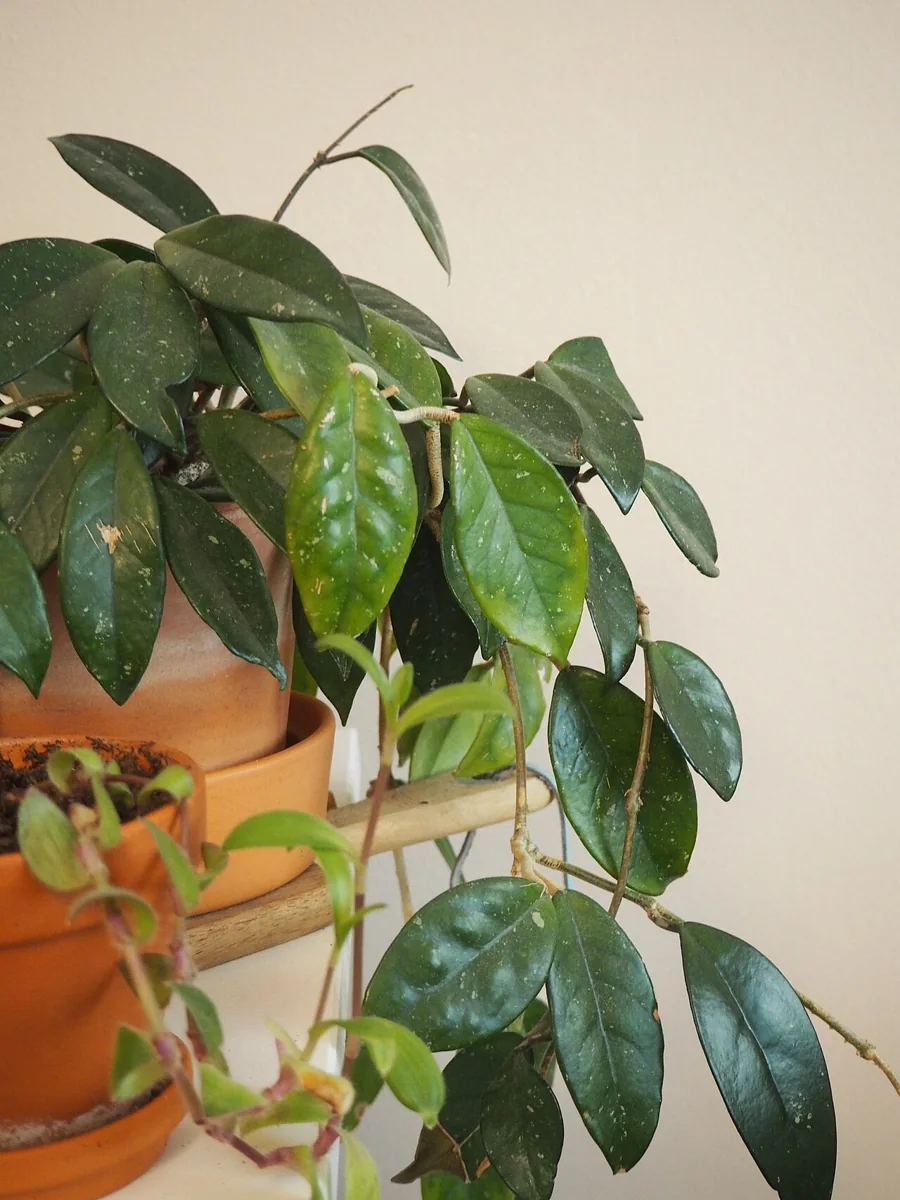
Somewhere, a Hoya has occupied the same shelf for years. Its stems wind around a support, a few leaves carry scratches and the pot looks surprisingly small. Then a flower cluster appears. Up close, the firm stars and coloured centres look almost manufactured. Hoya carnosa can be thoroughly familiar and still surprise you.
The RHS describes a vigorous evergreen climber with fleshy leaves and scented white or pale pink flowers with red centres. That describes the species, not every named selection. A cultivar name belongs to the plant's identity. A photograph of the green species cannot automatically confirm a variegated selection.
Keep the name you received
Record the supplied name before discarding the label. A photograph of it and a note about the source prevent a trade name from quietly becoming a confident identification later.
Look beyond one leaf. Photograph older and younger foliage, the growth habit and, eventually, the flowers. Lighting and age affect appearance. One glossy, backlit leaf makes an attractive image but a limited basis for identifying a cultivar. Keep the original name alongside any uncertainty rather than improving an uncertain label into a definite claim.
Leave the small flower stalk
After flowering, a short stalk remains. The RHS recommends retaining it because flowers can return from previous flowering points. Tidying can remove something that might bring pleasure again.
Photograph the first cluster before and after its flowers fall. That helps you recognise the flowering point among the stems before later pruning. Mark it on an overview photograph if useful; every stalk need not carry a physical label.
The first flowers are not an examination you have passed, and their absence does not make the plant worthless. Leaves, stems and the way it fills a support also belong to its appeal. Waiting only for flowers means missing much of the story already unfolding.
Observe a long stem before cutting
A shoot extending beyond a hoop can invite immediate pruning. First consider the whole plant. Where should new growth go? Does the support still suit the shape you want? Can you guide the stem without kinking or tightly binding it?
The RHS describes Hoya carnosa as vigorous. An extending shoot fits a climber using space. That does not mean every bare stem is healthy or must never be cut. It means that failing to fit inside a circle is not, by itself, a diagnosis. Decisions about shape and decisions about health are related but distinct.
Moving counts as a change
Flower buds can make you want to display the plant somewhere special. The RHS warns that changing light and excessively wet or dry compost can contribute to bud loss. Prefer to leave a budding plant in place when its position is suitable.
You can photograph it without moving the pot to another window. Record when buds appeared and what changed shortly beforehand. If buds fall, you then have context rather than a vague memory that the plant was difficult. A move and an altered watering approach made together are harder to interpret than one change.
Understand the pot as well as the leaves
Fleshy foliage is neither permission to dry the root ball completely nor a reason to keep topping it up. The RHS stresses an airy, well-drained medium. Our practical approach starts with the particular pot: its rooting, moisture at the checking point and changes since the previous observation.
A small pot in a warm, bright position needs a different assessment from a large pot in a cooler corner. An observation is more useful than insisting that this Hoya always receives the same treatment. Separate reservoir level from root-zone moisture. Moving into Pon or semi-hydro changes the growing system; it does not establish that previous thresholds remain valid.
A softer leaf should prompt a check rather than an automatic watering instruction. Describe which leaf changed, how it feels and whether the medium is still wet or has become drier. Recording what you can actually observe prevents an impression from becoming an assumed cause.
Feeding and repotting without haste
It is tempting to promise flowers through additional fertiliser, but the RHS calls for light feeding. Treat nutrition as support for growth, not a dial that always benefits from being turned up. Record the product and concentration so that later changes can be interpreted.
A large plant does not automatically need a much larger container. Examine the root ball and your reason for repotting: space, damage or an unsuitable medium? Match the next step to that problem. Changing pot, medium, position and feeding together makes recovery harder to understand.
Small checks make an old plant interesting
The RHS lists mealybugs as a possible pest. Inspect less photogenic places too: leaf axils, crossing stems and contact points at the support. Looking only at the upper leaves is not equivalent. Photograph anything suspicious before choosing a treatment.
A simple journal can increase enjoyment. The first bud, a new leaf and an overview of the stems show how your specimen develops. You do not need rare species to have something interesting to follow. An ordinary Hoya carnosa can provide years of reasons to look again.
Sources and limits
Species characteristics and general Hoya cultivation were checked against the RHS sources below on 6 October 2026. The growing guide covers multiple Hoyas and does not establish identical requirements for every species or cultivar. Naming records, journal examples and separate checks are our own practical interpretation, without fixed watering intervals or promises of flowering.