Houseplant care: guides and stories
Hoyas: more than waiting for flowers
If you only wait for the first bloom, you miss much of the enjoyment. Getting to know a Hoya starts with its name, its growth and the pot it lives in.
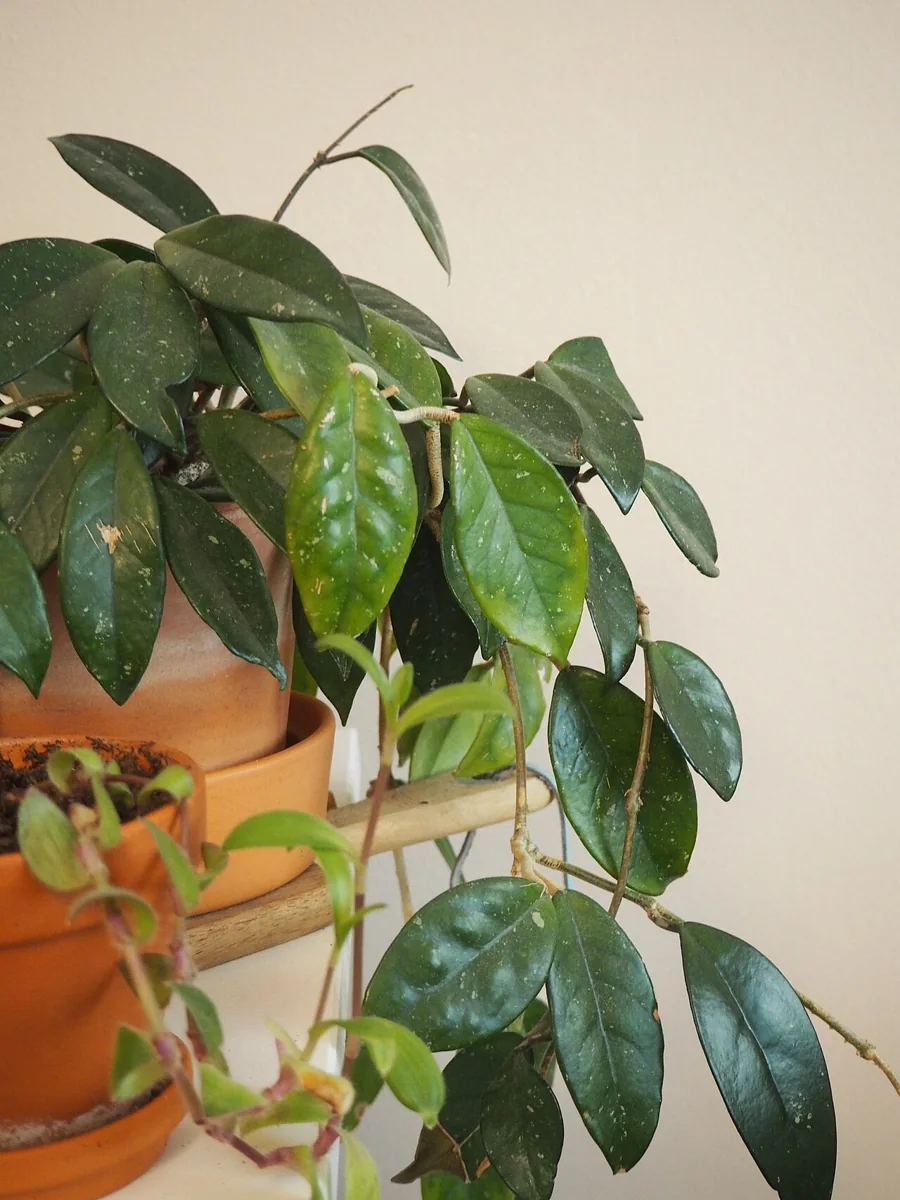
At some point a Hoya becomes more than a plant with attractive leaves. Buds appear on a small stalk and you start looking in its direction a little more often. The time before that need not be a waiting room. A new vine, a firmer leaf or a well-rooted cutting has a story too.
Give the label a second look
Hoya is a genus, rather than one species with one set of instructions. Hoya carnosa, Hoya linearis and plants sold as bella differ in more than appearance; the RHS also distinguishes their growing requirements. Advice for your carnosa cannot simply be applied to every other Hoya.
Keep the name under which you received the plant. Add a correction or synonym later without losing that starting information. A cultivar name belongs to its identity. A photograph labelled ‘Hoya’ does not prove the identity of your particular species or cultivar. The photograph here shows Hoya carnosa, rather than flowers representative of every Hoya.
A vine does not have to look tidy immediately
A windowsill plant is often expected to fit a carefully arranged picture. A new vine may disrupt that plan. Before cutting it, consider the direction in which you want the plant to grow. A suitable support or a place where it can trail gives you room to follow its development.
We would start with practical questions: can I still inspect the pot, see the backs of the leaves and move the plant without breaking anything? A beautiful but inaccessible arrangement makes essential checks harder. Appearance and ease of use do not have to compete.
Thick leaves are not water indicators
Fleshy leaves are a recognisable feature of Hoya carnosa. Even so, we would not wait for a limp plant before deciding whether it needs water. Inspect the root zone and learn how this pot dries. Pot size, medium, roots, light and temperature together give an observation its meaning.
A small cutting in a large pot needs a different assessment from an established plant in a well-rooted pot. With a reservoir system, record the refill level separately from the root-zone moisture threshold. ‘Every Hoya on Sunday’ looks tidy on paper, but overlooks those differences.
The little stalk after flowering
Hoya carnosa can flower again from its persistent flower stalks, as NC State explicitly notes. That is a reason not to cut everything away automatically after flowering. If you are unsure what a small projection is, photograph it and investigate it for your particular species first.
Flowering is something to enjoy anticipating, rather than force with additional feed. Follow the whole plant: is it growing, does the root zone remain suitable, and is the light position reasonably steady and appropriate? A calendar date cannot tell you whether it is ready.
Build your own comparison
Choose a consistent way to photograph your Hoya occasionally. A similar angle helps reveal new vines or changes in leaves later. Record a move, a new medium or different lighting alongside the photograph. A long weekly report is unnecessary.
Something useful then grows alongside the plant: a collection of observations. When flowers arrive, you have more than a beautiful picture. You know a little more about how the plant got there.